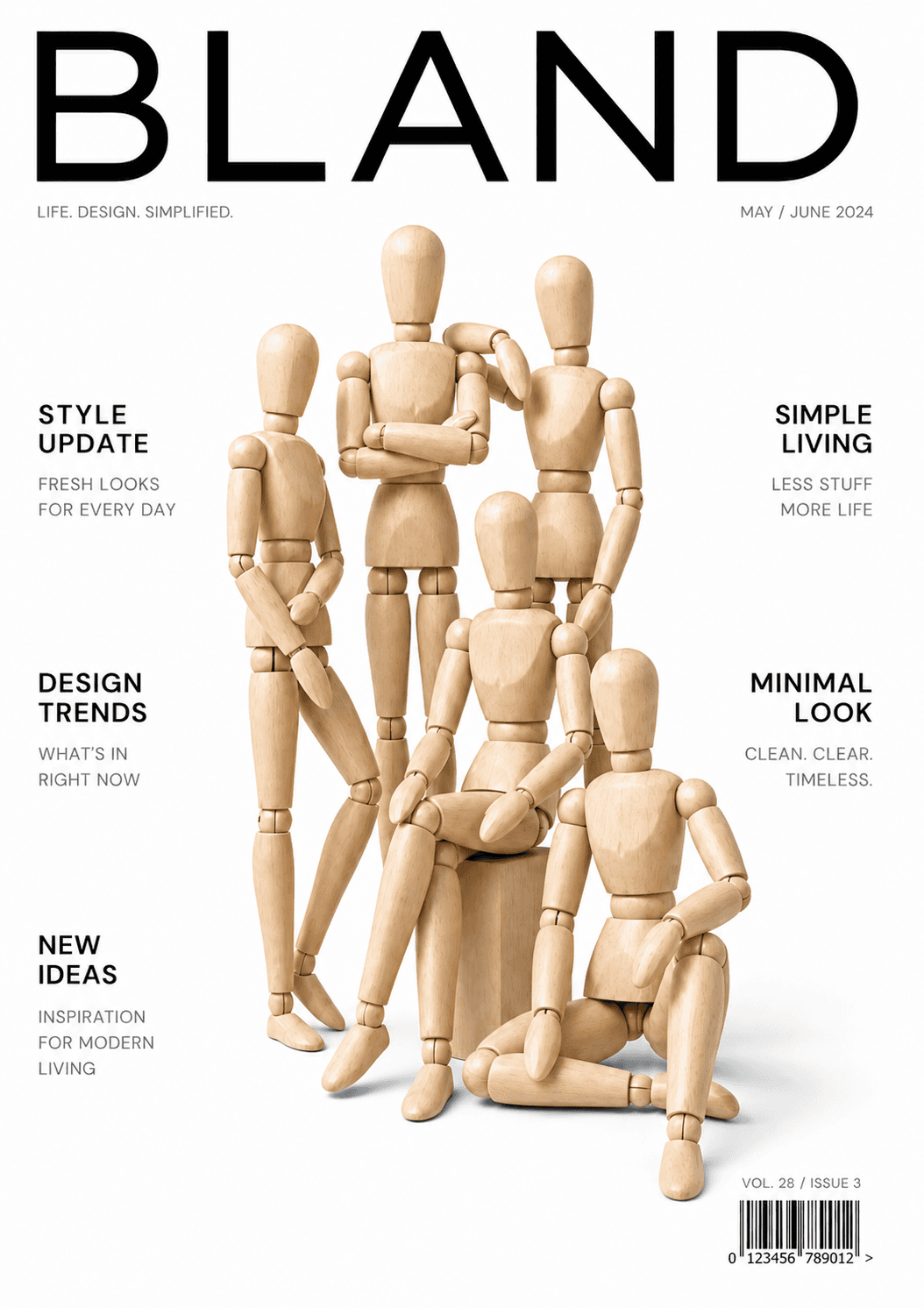
Why Bland Web Design Kills Conversions
Brutalist, minimalist, and hyper-functional design promised clarity. Too often, they gave us cold, forgettable UX.

F.J. Abrahams
CCO & Principal. Leading the Changer against cognitive friction
Why Bland Web Design Kills Conversions
Brutalist, minimalist, and hyper-functional design promised clarity. Too often, they gave us cold, forgettable UX.
F.J. Abrahams
CCO & Principal. Leading the Changer against cognitive friction
The problem is not simplicity. It is what happens when companies confuse less effort for better design, strip away the cues people need, and call the result “clean.”
At some point, digital design confused restraint with absence.
It happened slowly, then everywhere.
Websites got flatter. Apps got duller. Buttons became more generic.
Forms became longer than they needed to be.
Simple tasks turned into endless processes.
Interfaces started looking cleaner while the actual experience became more confusing.
Not because this was better for people.
Because it was easier for organizations.
Easier to measure. Easier to scale. Easier to defend in a stakeholder meeting.
That is the strange contradiction of modern product design: we have never had more research, more tools, more behavioral data, more access to audiences, more channels to reach people.
And somehow, we keep building digital experiences that feel less human, less helpful, and less memorable.
Efficient for the business. Exhausting for the person.
The Problem Is Not Simplicity
Simplicity is not the enemy.
Real simplicity is one of the hardest things to achieve in design. It takes discipline, taste, and the confidence to remove what does not matter to the person using it, without accidentally removing the cues, context, and reassurance they need to move forward.
That distinction matters, because too many digital experiences assume people are interested enough, patient enough, or desperate enough to figure it out.
They are not.
People do not owe your website their concentration.
If the path is messy, unclear, generic, or exhausting, they leave.
And honestly, they should.
The problem is oversimplification.
Oversimplification happens when teams confuse “less” with “better.”
When visual cues disappear because someone decided they were noise.
When brand expression gets flattened because users “just need to complete the task.”
When accessibility requirements are treated as limits instead of foundations.
That is when simplicity becomes bland.
That is not design. That is fear dressed up as taste.
The Rise of Hyper-Functionality
There is a version of product design right now that worships function so completely it forgets why the function exists.
Call it hyper-functionality. Call it digital brutalism. Call it the logical endpoint of too many design systems, too many conversion dashboards, too many people saying “just make it usable” as if usability is the finish line.
The idea sounds responsible: remove distractions, prioritize the task, reduce friction, respect attention.
All good things.
But taken too far, this logic creates a very specific kind of digital deadness. A world where everything technically works, but nothing speaks. Where every product is clear enough to pass review, but none of it is memorable. Where the interface gets out of the way so completely that the brand disappears with it.
This is especially dangerous for companies trying to build trust, loyalty, or cultural relevance.
Because people do not remember efficiency alone.
They remember whether something helped them understand. They remember whether it respected their time, anticipated their uncertainty, made a hard thing feel easier, or gave them a reason to come back.
Function gets people through a door.
Meaning gives them a reason to remember the room.
Best Practices Became the Ceiling
The tragedy is that many of the ideas behind this shift started from a good place.
Accessibility matters. Performance matters. Usability matters. Nobody is arguing for mystery-meat navigation, unreadable typography, or websites that behave like haunted furniture.
Best practices exist for a reason. Accessibility requirements exist for a reason. They protect people from bad design decisions dressed up as creativity.
But somewhere along the way, these standards stopped being treated as the foundation and started being treated as the entire house.
Meet the requirement. Follow the pattern. Reduce the options. Remove the flourish. Flatten the hierarchy. Make it clean.
The result is often technically acceptable and experientially forgettable.
Accessibility should not mean stripping away every visual cue. Usability should not mean removing every moment of personality. Clarity should not mean sanding the experience down until there is nothing left to recognize.
A visual cue is not automatically clutter. A moment of delight is not automatically distraction. A strong point of view is not automatically friction.
Sometimes the thing being removed is the thing helping people understand.
We Keep Designing for the Device Instead of the Person
UX likes to talk about intention, task, and context.
But when the word “context” comes up, the conversation usually runs straight to the device.
Mobile or desktop. Viewport size. Browser. Connection speed. Dark mode. Light mode.
Useful? Absolutely.
But also wildly incomplete.
Before the device, there is a person.
A person who may be tired, rushed, distracted, skeptical, curious, overwhelmed, excited, anxious, multitasking, commuting, caring for someone, hiding in the bathroom for three quiet minutes, or trying to make a decision at 11:47 p.m. with six tabs open and no emotional bandwidth left.
That is context.
Not just the screen. The situation.
And this is where a lot of product design still falls short. It designs for the user as a clean abstraction: motivated, focused, rational, available.
A little fictional creature with perfect Wi-Fi and no inner life.
But people do not arrive at digital experiences as “users.” They arrive as themselves. With moods, habits, doubts, preferences, pressures, histories, cognitive styles, and real-world interruptions.
The more we ignore that, the more we build products that are technically usable and emotionally clueless.
The Border Between Simple and Bland
The border between simple and bland is painfully thin.
The difference is purpose.
Simple design knows what it is trying to do. Bland design only knows what it is trying to avoid.
Simple design removes noise. Bland design removes character. Simple design creates focus. Bland design creates sameness. Simple design respects attention. Bland design assumes attention is the only thing people need.
This is why simplification is not a junior skill. It is not something you get by deleting half the page and calling it a system.
Simplification takes years to master because it requires judgment. You have to know what to keep. You have to know what to protect. You have to understand which details carry meaning and which ones are just decorative confetti.
The best simple experiences do not feel empty.
They feel considered.
That is the difference.
Innovation Does Not Come From Removing More
Innovation does not happen because a team removed another color, another sentence, another image, another cue, another bit of warmth.
Innovation happens when a product understands people better than the previous version of the world did.
It answers questions people did not know how to ask. It reduces confusion before it becomes frustration. It guides without patronizing. It surprises without derailing. It feels obvious only after someone else has done the hard work of making it so.
That is not decoration.
That is care.
And care is not soft. Care is a competitive advantage.
A brand that understands context can make people feel seen. A product that anticipates uncertainty can build trust faster. An interface that respects cognitive load can help people make better decisions. A digital experience that feels human can become memorable in a market full of competent sameness.
This is where the next wave of design has to go.
Not more brutal. Not more generic. Not more “clean” at the expense of meaning.
More aware.
Design With Manners
The future of digital design is not about choosing between function and expression.
That is a false choice.
The future belongs to experiences that are useful and memorable. Clear and human. Accessible and distinctive. Simple because they are deeply understood, not because they have been stripped of purpose.
At Internauts, we call this Concierge Design.
It is the idea that digital experiences should behave less like static interfaces and more like thoughtful hosts. They should anticipate needs, clarify choices, reduce unnecessary effort, and respect the person moving through them.
That does not mean adding more stuff.
It means adding more consideration.
Because the purpose of an interaction does not come from the layout. It does not come from the trend. It does not come from whatever visual language everyone else is copying this quarter.
Purpose comes from the person the interaction is built for.
When we understand their context, we can build experiences that feel less like systems people have to operate and more like environments that know how to receive them.
We can surprise instead of confuse. Guide instead of interrupt. Deliver instead of frustrate.
That is hospitality.
That is Concierge Design.
That is the core of Design with Manners.
And maybe that is what digital design needs now.
Not less creativity.
Not less accessibility.
Not less simplicity.
Just fewer products pretending that emptiness is the same thing as clarity.
Because before someone is a user, a visitor, a lead, a conversion, or a data point, they are a person. And when design forgets the person, the symptoms show up everywhere.
Bounce rate.
Form abandonment.
Cart abandonment.
Drop-offs.
Confusion.
Hesitation.
Silence.
Those are not just analytics problems. They are symptoms of cognitive friction.
Friction that often could have been avoided with a little more care for the person using the thing.
A clearer path.
A better cue.
A warmer explanation.
A more thoughtful question.
A moment of reassurance before the moment of decision.
That is the point.
Better design is not about adding more. It is about caring better.
And care, when done right, is not decoration.
It is strategy.
At some point, digital design confused restraint with absence.
It happened slowly, then everywhere.
Websites got flatter. Apps got duller. Buttons became more generic.
Forms became longer than they needed to be.
Simple tasks turned into endless processes.
Interfaces started looking cleaner while the actual experience became more confusing.
Not because this was better for people.
Because it was easier for organizations.
Easier to measure. Easier to scale. Easier to defend in a stakeholder meeting.
That is the strange contradiction of modern product design: we have never had more research, more tools, more behavioral data, more access to audiences, more channels to reach people.
And somehow, we keep building digital experiences that feel less human, less helpful, and less memorable.
Efficient for the business. Exhausting for the person.
The Problem Is Not Simplicity
Simplicity is not the enemy.
Real simplicity is one of the hardest things to achieve in design. It takes discipline, taste, and the confidence to remove what does not matter to the person using it, without accidentally removing the cues, context, and reassurance they need to move forward.
That distinction matters, because too many digital experiences assume people are interested enough, patient enough, or desperate enough to figure it out.
They are not.
People do not owe your website their concentration.
If the path is messy, unclear, generic, or exhausting, they leave.
And honestly, they should.
The problem is oversimplification.
Oversimplification happens when teams confuse “less” with “better.”
When visual cues disappear because someone decided they were noise.
When brand expression gets flattened because users “just need to complete the task.”
When accessibility requirements are treated as limits instead of foundations.
That is when simplicity becomes bland.
That is not design. That is fear dressed up as taste.
The Rise of Hyper-Functionality
There is a version of product design right now that worships function so completely it forgets why the function exists.
Call it hyper-functionality. Call it digital brutalism. Call it the logical endpoint of too many design systems, too many conversion dashboards, too many people saying “just make it usable” as if usability is the finish line.
The idea sounds responsible: remove distractions, prioritize the task, reduce friction, respect attention.
All good things.
But taken too far, this logic creates a very specific kind of digital deadness. A world where everything technically works, but nothing speaks. Where every product is clear enough to pass review, but none of it is memorable. Where the interface gets out of the way so completely that the brand disappears with it.
This is especially dangerous for companies trying to build trust, loyalty, or cultural relevance.
Because people do not remember efficiency alone.
They remember whether something helped them understand. They remember whether it respected their time, anticipated their uncertainty, made a hard thing feel easier, or gave them a reason to come back.
Function gets people through a door.
Meaning gives them a reason to remember the room.
Best Practices Became the Ceiling
The tragedy is that many of the ideas behind this shift started from a good place.
Accessibility matters. Performance matters. Usability matters. Nobody is arguing for mystery-meat navigation, unreadable typography, or websites that behave like haunted furniture.
Best practices exist for a reason. Accessibility requirements exist for a reason. They protect people from bad design decisions dressed up as creativity.
But somewhere along the way, these standards stopped being treated as the foundation and started being treated as the entire house.
Meet the requirement. Follow the pattern. Reduce the options. Remove the flourish. Flatten the hierarchy. Make it clean.
The result is often technically acceptable and experientially forgettable.
Accessibility should not mean stripping away every visual cue. Usability should not mean removing every moment of personality. Clarity should not mean sanding the experience down until there is nothing left to recognize.
A visual cue is not automatically clutter. A moment of delight is not automatically distraction. A strong point of view is not automatically friction.
Sometimes the thing being removed is the thing helping people understand.
We Keep Designing for the Device Instead of the Person
UX likes to talk about intention, task, and context.
But when the word “context” comes up, the conversation usually runs straight to the device.
Mobile or desktop. Viewport size. Browser. Connection speed. Dark mode. Light mode.
Useful? Absolutely.
But also wildly incomplete.
Before the device, there is a person.
A person who may be tired, rushed, distracted, skeptical, curious, overwhelmed, excited, anxious, multitasking, commuting, caring for someone, hiding in the bathroom for three quiet minutes, or trying to make a decision at 11:47 p.m. with six tabs open and no emotional bandwidth left.
That is context.
Not just the screen. The situation.
And this is where a lot of product design still falls short. It designs for the user as a clean abstraction: motivated, focused, rational, available.
A little fictional creature with perfect Wi-Fi and no inner life.
But people do not arrive at digital experiences as “users.” They arrive as themselves. With moods, habits, doubts, preferences, pressures, histories, cognitive styles, and real-world interruptions.
The more we ignore that, the more we build products that are technically usable and emotionally clueless.
The Border Between Simple and Bland
The border between simple and bland is painfully thin.
The difference is purpose.
Simple design knows what it is trying to do. Bland design only knows what it is trying to avoid.
Simple design removes noise. Bland design removes character. Simple design creates focus. Bland design creates sameness. Simple design respects attention. Bland design assumes attention is the only thing people need.
This is why simplification is not a junior skill. It is not something you get by deleting half the page and calling it a system.
Simplification takes years to master because it requires judgment. You have to know what to keep. You have to know what to protect. You have to understand which details carry meaning and which ones are just decorative confetti.
The best simple experiences do not feel empty.
They feel considered.
That is the difference.
Innovation Does Not Come From Removing More
Innovation does not happen because a team removed another color, another sentence, another image, another cue, another bit of warmth.
Innovation happens when a product understands people better than the previous version of the world did.
It answers questions people did not know how to ask. It reduces confusion before it becomes frustration. It guides without patronizing. It surprises without derailing. It feels obvious only after someone else has done the hard work of making it so.
That is not decoration.
That is care.
And care is not soft. Care is a competitive advantage.
A brand that understands context can make people feel seen. A product that anticipates uncertainty can build trust faster. An interface that respects cognitive load can help people make better decisions. A digital experience that feels human can become memorable in a market full of competent sameness.
This is where the next wave of design has to go.
Not more brutal. Not more generic. Not more “clean” at the expense of meaning.
More aware.
Design With Manners
The future of digital design is not about choosing between function and expression.
That is a false choice.
The future belongs to experiences that are useful and memorable. Clear and human. Accessible and distinctive. Simple because they are deeply understood, not because they have been stripped of purpose.
At Internauts, we call this Concierge Design.
It is the idea that digital experiences should behave less like static interfaces and more like thoughtful hosts. They should anticipate needs, clarify choices, reduce unnecessary effort, and respect the person moving through them.
That does not mean adding more stuff.
It means adding more consideration.
Because the purpose of an interaction does not come from the layout. It does not come from the trend. It does not come from whatever visual language everyone else is copying this quarter.
Purpose comes from the person the interaction is built for.
When we understand their context, we can build experiences that feel less like systems people have to operate and more like environments that know how to receive them.
We can surprise instead of confuse. Guide instead of interrupt. Deliver instead of frustrate.
That is hospitality.
That is Concierge Design.
That is the core of Design with Manners.
And maybe that is what digital design needs now.
Not less creativity.
Not less accessibility.
Not less simplicity.
Just fewer products pretending that emptiness is the same thing as clarity.
Because before someone is a user, a visitor, a lead, a conversion, or a data point, they are a person. And when design forgets the person, the symptoms show up everywhere.
Bounce rate.
Form abandonment.
Cart abandonment.
Drop-offs.
Confusion.
Hesitation.
Silence.
Those are not just analytics problems. They are symptoms of cognitive friction.
Friction that often could have been avoided with a little more care for the person using the thing.
A clearer path.
A better cue.
A warmer explanation.
A more thoughtful question.
A moment of reassurance before the moment of decision.
That is the point.
Better design is not about adding more. It is about caring better.
And care, when done right, is not decoration.
It is strategy.


Discover more about high-performance web design. Follow us on LinkedIn and Instagram.