Designed for brains Designed for conversion
Designed for brains Designed for conversion
Designed for brains Designed for conversion
This is it
Bad design does not just frustrate people.
It disables them.
Most digital experiences look fine.
Then people hesitate, skim, get confused, lose trust, abandon the form, close the tab, or choose someone else.
That is not always a design problem.
It is cognitive friction.
Neurodigital™ Design helps reduce the invisible mental work that keeps people from understanding, trusting, and taking action.
Less confusion.
More confidence.
Better conversion.
Bad design does not just frustrate people.
It disables them.
Most digital experiences look fine.
Then people hesitate, skim, get confused, lose trust, abandon the form, close the tab, or choose someone else.
That is not always a design problem.
It is cognitive friction.
Neurodigital™ Design helps reduce the invisible mental work that keeps people from understanding, trusting, and taking action.
Less confusion.
More confidence.
Better conversion.
Best practices help you pass
We help people move
Bad design does not just frustrate people.
It disables them.
Most digital experiences look fine.
Then people hesitate, skim, get confused, lose trust, abandon the form, close the tab, or choose someone else.
That is not always a design problem.
It is cognitive friction.
Neurodigital™ Design helps reduce the invisible mental work that keeps people from understanding, trusting, and taking action.
Less confusion.
More confidence.
Better conversion.
Best practices help you pass
We help people move
Cognitive friction is expensive
Cognitive friction is expensive
This is what
One of the most common reasons you are leaving money at the table and it's shows up as: High bounce rates, form abandonment, low engagement, weak trust, unclear customer journeys, poor content performance, too many support questions, people choosing a competitor who explains things better
One of the most common reasons you are leaving money at the table and it's shows up as: High bounce rates, form abandonment, low engagement, weak trust, unclear customer journeys, poor content performance, too many support questions, people choosing a competitor who explains things better
The problem is rarely one giant mistake
It is usually a stack of small frictions
The problem is rarely one giant mistake
It is usually a stack of small frictions
Tiny things. Expensive consequences.
Tiny things.
Expensive consequences.
Small frictions compound
your losses
One of the most common reasons you are leaving money at the table and it's shows up as: High bounce rates, form abandonment, low engagement, weak trust, unclear customer journeys, poor content performance, too many support questions, people choosing a competitor who explains things better
The problem is rarely one giant mistake
It is usually a stack of small frictions
Tiny things. Expensive consequences.
Small frictions compound
your losses
Mobile visitors abandon pages that take longer than three seconds to load.
Mobile visitors abandon pages that take longer than three seconds to load.
Friction makes people leave before the brand gets a fair shot.
of people leaves before your brand gets a fair shot. Friction is making you lose Brand Equity.
of people leaves before your brand gets a fair shot. Friction is making you lose Brand Equity.
of shoppers abandon the checkout when the process feels too long or confusing.
of shoppers abandon the checkout when the process feels too long or confusing.
Bad experience does not just hurt conversion.
It teaches people what your brand feels like.
Bad experience does not just hurt conversion. It teaches people what your brand feels like.
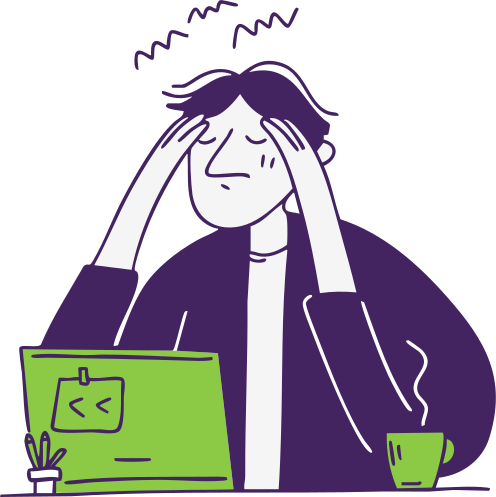
Good design still fails when people have to work too hard
Good design still fails when people have to work too hard
Good design still fails when people have to work too hard
This is why
BOUNCE takes one CLICK
If people leave, the rest of the page doesn’t matter.
How much it cost to bring them back?
Your website can look polished, load fast, follow best practices, and still underperform.
Because people are not judging the experience only by how it looks.
They are asking:
Do I understand what this is?
Do I trust what happens next?
Can I find what I need?
Is this worth my effort?
Am I confident enough to act?
When the answer is unclear, people do not always complain.
They leave.
No dramatic exit.
No angry email.
No useful feedback.
Just a quiet little conversion funeral.
Your website can look polished, load fast, follow best practices, and still underperform.
Because people are not judging the experience only by how it looks.
They are asking:
Do I understand what this is?
Do I trust what happens next?
Can I find what I need?
Is this worth my effort?
Am I confident enough to act?
When the answer is unclear, people do not always complain.
They leave.
No dramatic exit.
No angry email.
No useful feedback.
Just a quiet little conversion funeral.
The pschology behind your website
Your website can look polished, load fast, follow best practices, and still underperform.
Because people are not judging the experience only by how it looks.
They are asking:
Do I understand what this is?
Do I trust what happens next?
Can I find what I need?
Is this worth my effort?
Am I confident enough to act?
When the answer is unclear, people do not always complain.
They leave.
No dramatic exit.
No angry email.
No useful feedback.
Just a quiet little conversion funeral.
The pschology behind your website
This is how you fix it
Neurodigital: Brain Science meets Hospitality Design
Neurodigital Design is Internauts’ framework for designing digital experiences around how people think, process, decide, trust, and act.
It helps us identify where people hesitate, misunderstand, lose confidence, or abandon the path.
Then we redesign the experience so the next step feels obvious, useful, and worth taking.
Neurodigital Design is Internauts’ framework for designing digital experiences around how people think, process, decide, trust, and act.
It helps us identify where people hesitate, misunderstand, lose confidence, or abandon the path.
Then we redesign the experience so the next step feels obvious, useful, and worth taking.
The shift between instructional to intentional digital experiences.
Neurodigital: Brain Science meets Hospitality Design
Neurodigital Design is Internauts’ framework for designing digital experiences around how people think, process, decide, trust, and act.
It helps us identify where people hesitate, misunderstand, lose confidence, or abandon the path.
Then we redesign the experience so the next step feels obvious, useful, and worth taking.
The shift between instructional to intentional digital experiences.

Cognitive science
How people process information and make decisions
Behavioral insight
How trust, attention, urgency, emotion, and context shape action
Behavioral insight
How trust, attention, urgency, emotion, and context shape action
Lived experience
Because real users do not behave like tidy personas in a stakeholder deck.
Lived experience
Because real users do not behave like tidy personas in a stakeholder deck.
AI-assisted evaluation
Find friction patterns faster.
Turn insights into better tools and service paths.
Design craft
Because the solution still has to look, feel, and work beautifully.
Design craft
Because the solution still has to look, feel, and work beautifully.
The Psychology
We design for people, not just personas
Personas tell you who someone might be.
States tell you what condition they are in when they arrive.
That matters.
The same person can behave differently depending on whether they are calm, rushed, skeptical, distracted, curious, overwhelmed, or ready to buy.
Neurodigital Design looks at six practical user states:
How much mental capacity does this person have right now?
Cognitive State
Emotional State
Situational State
How much mental capacity does this person have right now?
Cognitive State
What are they feeling as they move through the experience?
Emotional State
What context surrounds the interaction?
Situational State
How focused or fragmented is their attention?
Attention State
How immediate or high-stakes is the need?
Urgency State
How confident are they in the brand, page, system, or next step?
Trust State
How focused or fragmented is their attention?
Attention State
Urgency State
Trust State
In Practice
Where Neurodigital™ Design shows up
Neurodigital™ Design applies anywhere people need to understand, decide, trust, or complete a task.

Website
Clearer pages. Stronger paths. Less guessing.
Website
Clearer pages. Stronger paths. Less guessing.

Forms
Lower abandonment by reducing confusion and decision fatigue.
Forms
Lower abandonment by reducing confusion and decision fatigue.

Navigation
Help people find the right path without decoding the org chart.
Navigation
Help people find the right path without decoding the org chart.

Content Systems
Turn scattered information into structured guidance.
Content Systems
Turn scattered information into structured guidance.

Service Flows
Make multi-step processes feel clear and humane.
Service Flows
Make multi-step processes feel clear and humane.

AI Experiences
Move from instructional interfaces to intentional ones.
AI Experiences
Move from instructional interfaces to intentional ones.
In Practice
In Practice
Where Neurodigital Design shows up
Neurodigital™ Design applies anywhere people need to understand, decide, trust, or complete a task.

Website
Clearer pages. Stronger paths. Less guessing.
Website
Clearer pages. Stronger paths. Less guessing.

Forms
Lower abandonment by reducing confusion and decision fatigue.
Forms
Lower abandonment by reducing confusion and decision fatigue.

Navigation
Help people find the right path without decoding the org chart.
Navigation
Help people find the right path without decoding the org chart.

Content Systems
Turn scattered information into structured guidance.
Content Systems
Turn scattered information into structured guidance.

Service Flows
Make multi-step processes feel clear and humane.
Service Flows
Make multi-step processes feel clear and humane.

AI Experiences
Move from instructional interfaces to intentional ones.
AI Experiences
Move from instructional interfaces to intentional ones.
Neurodigital in the wild
Neurodigital in the wild
Neurodigital Design applies anywhere people need to understand, decide, trust, or complete a task.
Neurodigital™ Design applies anywhere people need to understand, decide, trust, or complete a task, here are some examples of our work
J.Jill / Retail UX + ecommerce clarity
J.Jill / Retail UX + ecommerce clarity
Neurodigital move:
Clarify product paths around fit, style, comparison and reassurance.
Result:
Easier browsing, better confidence and less decision fatigue.
P&G Enterprise comms systems
P&G Enterprise comms systems
Neurodigital move:
Simplify structure, sharpen messaging and reduce cognitive load.
Result:
Faster understanding, stronger alignment and better decision quality.
ShopRite / Grocery ecommerce + task flow
ShopRite / Grocery ecommerce + task flow
Neurodigital move:
Simplify repeat purchases, substitutions, deals, pickup and next steps.
Result:
Faster tasks, higher trust and less digital grocery chaos.
How it works
We look at the behavior of the experience, not just the components.
Map the journey
We identify where people enter, what they need, what they expect, and where they are likely to hesitate.
2
Find the friction
We review content, layout, hierarchy, navigation, forms, CTAs, interaction patterns, and decision points.
3
Diagnose the state
We evaluate where the experience creates cognitive load, emotional uncertainty, urgency mismatch, attention loss, or trust gaps.
4
Redesign the path
We make the next step clearer, reduce unnecessary effort, improve confidence, and support better decisions.
5
Build the system
We turn the work into content, design patterns, UX improvements and implementation-ready guidance.
Map the journey
We identify where people enter, what they need, what they expect, and where they are likely to hesitate.
2
Find the friction
We review content, layout, hierarchy, navigation, forms, CTAs, interaction patterns, and decision points.
3
Diagnose the state
We evaluate where the experience creates cognitive load, emotional uncertainty, urgency mismatch, attention loss, or trust gaps.
4
Redesign the path
We make the next step clearer, reduce unnecessary effort, improve confidence, and support better decisions.
5
Build the system
We turn the work into content, design patterns, UX improvements and implementation-ready guidance.

Map the journey
We identify where people enter, what they need, what they expect, and where they are likely to hesitate.
Map Journey
Find Friction
Diagnose the State
Redesign the Path
Build the System
Powered by
Powered by

Our AI-assisted Neurodigital tools help us find friction patterns, evaluate experience behavior, and pressure-test recommendations faster.
Our AI-assisted Neurodigital tools help us find friction patterns, evaluate experience behavior, and pressure-test recommendations faster.
Our AI-assisted Neurodigital tools help us find friction patterns, evaluate experience behavior, and pressure-test recommendations faster.
Methods
Methods
How we uncover what works and what doesn't
How we uncover what works and what doesn't


Friction is the gap between intent and action. We measure where users stumble, hesitate, or abandon. Eye tracking, task analysis, and behavioral observation reveal the invisible barriers in your interface.
We don't assume understanding. Comprehension testing shows us what sticks and what confuses. Through moderated sessions and unmoderated studies, we watch how real people parse your content and navigate your systems.
Attention is finite. We apply principles from cognitive psychology to guide focus where it matters. Hierarchy, contrast, and spatial grouping work together to make important information impossible to miss.
Short-term memory holds roughly seven items. We structure information in chunks, use progressive disclosure, and reinforce key concepts through repetition and visual anchors that make recall effortless.
Neuroinclusive design serves neurodivergent minds alongside neurotypical ones. Clear language, predictable patterns, reduced cognitive load, and accessible color contrast benefit everyone. It's not a special feature. It's how good design works.
Because we do not treat design like decoration. We look at how your experience behaves. Where people hesitate. Where trust drops. Where language gets foggy. Where navigation gets cute instead of useful. Where the brand promise falls apart because the path does not match the pitch. Then we fix the parts that matter. We bring strategy, taste, accessibility, technical execution and a healthy disrespect for generic digital nonsense. The goal is not just a better-looking website. The goal is a digital experience people understand, trust and remember.
Friction is the gap between intent and action. We measure where users stumble, hesitate, or abandon. Eye tracking, task analysis, and behavioral observation reveal the invisible barriers in your interface.
We don't assume understanding. Comprehension testing shows us what sticks and what confuses. Through moderated sessions and unmoderated studies, we watch how real people parse your content and navigate your systems.
Attention is finite. We apply principles from cognitive psychology to guide focus where it matters. Hierarchy, contrast, and spatial grouping work together to make important information impossible to miss.
Short-term memory holds roughly seven items. We structure information in chunks, use progressive disclosure, and reinforce key concepts through repetition and visual anchors that make recall effortless.
Neuroinclusive design serves neurodivergent minds alongside neurotypical ones. Clear language, predictable patterns, reduced cognitive load, and accessible color contrast benefit everyone. It's not a special feature. It's how good design works.
Because we do not treat design like decoration. We look at how your experience behaves. Where people hesitate. Where trust drops. Where language gets foggy. Where navigation gets cute instead of useful. Where the brand promise falls apart because the path does not match the pitch. Then we fix the parts that matter. We bring strategy, taste, accessibility, technical execution and a healthy disrespect for generic digital nonsense. The goal is not just a better-looking website. The goal is a digital experience people understand, trust and remember.

Friction is the gap between intent and action. We measure where users stumble, hesitate, or abandon. Eye tracking, task analysis, and behavioral observation reveal the invisible barriers in your interface.
We don't assume understanding. Comprehension testing shows us what sticks and what confuses. Through moderated sessions and unmoderated studies, we watch how real people parse your content and navigate your systems.
Attention is finite. We apply principles from cognitive psychology to guide focus where it matters. Hierarchy, contrast, and spatial grouping work together to make important information impossible to miss.
Short-term memory holds roughly seven items. We structure information in chunks, use progressive disclosure, and reinforce key concepts through repetition and visual anchors that make recall effortless.
Neuroinclusive design serves neurodivergent minds alongside neurotypical ones. Clear language, predictable patterns, reduced cognitive load, and accessible color contrast benefit everyone. It's not a special feature. It's how good design works.
Because we do not treat design like decoration. We look at how your experience behaves. Where people hesitate. Where trust drops. Where language gets foggy. Where navigation gets cute instead of useful. Where the brand promise falls apart because the path does not match the pitch. Then we fix the parts that matter. We bring strategy, taste, accessibility, technical execution and a healthy disrespect for generic digital nonsense. The goal is not just a better-looking website. The goal is a digital experience people understand, trust and remember.
What you
walk away with
What you
walk away with
Cognitive Friction Audit
A focused review of content, layout, navigation, forms, hierarchy, interaction patterns, and decision points.
Neurodigital Guidelines
Practical recommendations for clarity, structure, UX, decision support, and interaction behavior.
Experience Roadmap
A prioritized plan for what to fix first, what to improve next, and what to redesign for long-term performance.
Content and UX Support
Sharper language, clearer hierarchy, stronger CTAs, and better user paths.
Implementation roadmap
Support moving from strategy to design, build, and launch.
Cognitive Friction Audit
A focused review of content, layout, navigation, forms, hierarchy, interaction patterns, and decision points.
Neurodigital Guidelines
Practical recommendations for clarity, structure, UX, decision support, and interaction behavior.
Experience Roadmap
A prioritized plan for what to fix first, what to improve next, and what to redesign for long-term performance.
Content and UX Support
Sharper language, clearer hierarchy, stronger CTAs, and better user paths.
Implementation roadmap
Support moving from strategy to design, build, and launch.
Here is more about Neurodigital design
Here is more about Neurodigital design
Here is more about Neurodigital design
Stay informed about our latest projects, trends, and industry insights.


internauts
What’s new
in digital?
What’s new
in digital?

Let's turn friction into conversion!
If your website, product, form, or service flow is making people work too hard, we’ll help you find where they get stuck and what to fix first.
Make the experience easier to understand, easier to trust, and harder to abandon.

© 2026 internauts™ Studio
Let's turn friction into conversion!
If your website, product, form, or service flow is making people work too hard, we’ll help you find where they get stuck and what to fix first.
Make the experience easier to understand, easier to trust, and harder to abandon.
© 2026 internauts™ Studio
Let's turn friction into conversion!
If your website, product, form, or service flow is making people work too hard, we’ll help you find where they get stuck and what to fix first.
Make the experience easier to understand, easier to trust, and harder to abandon.